

Your first app release shouldn’t be a smaller version of your final vision. It should be the clearest way to learn what users actually need. The app development process for startups can feel uncertain before a line of code is written: which features belong in the first release, what needs testing, and how should design and engineering stay aligned?
A focused plan turns those questions into decisions you can review at each milestone. Start with the user problem, define the essential journey, and test assumptions before expanding scope. This keeps the first release manageable and protects the quality and usability that give people a reason to return.
This guide follows the journey from product discovery to launch and beyond. You’ll see what to decide at each phase, how to work with a product development team, and how research-driven UI/UX design connects with engineering. We’ll also cover testing, app store deployment, and using post-release analytics and feedback to refine what comes next.
Key Takeaways
- Map each development stage to a decision or deliverable you can review before moving forward.
- Keep the first release focused by weighing the user problem, essential outcome, available evidence, and implementation effort.
- Use milestone reviews to assess working user journeys, unresolved questions, and next priorities, not just tasks completed.
- Prepare for launch by reviewing core flows, defects, and app store submission needs, then use analytics to guide improvements.
- A clear app development process for startups turns uncertainty into evidence, helping founders make more confident product decisions.
What does the app development process for startups actually involve?
The app development process for startups connects product decisions, design, engineering, testing, release preparation, and learning. It’s more than handing a team a feature list and waiting for an app to appear. Each decision shapes what comes next, from the user journey and interface to the technical foundations behind it.
For a startup, the process should reduce uncertainty before major commitments. Validate the problem, clarify who the product serves, and prioritise the outcome users need first. This helps the team focus effort on evidence rather than assumptions, while leaving room to refine the product as you learn. Put simply, it’s a repeatable path from assumption to evidence.
Which stages usually shape a startup app project?
A typical project moves through discovery, product definition, UX/UI design, development, testing, and release. Discovery explores the user problem; product definition turns findings into priorities; design shapes the flows and interface; engineering makes them work; testing checks quality and usability; and release prepares the app for users. Wikipedia’s overview of the mobile app development process provides a broader technical view of the lifecycle.
These stages aren’t rigid hand-offs. Design and engineering inform each other, testing can expose gaps in an assumption, and user feedback may shift priorities. The right scope and sequence depend on the product, its audience, and the business goal. A startup validating a new booking experience, for example, can test whether users can find an available service and complete a booking before investing in secondary features.
What should founders have ready before development starts?
You don’t need every screen specified. You do need a shared starting point: the user problem, the intended audience, and the outcome the product should enable. Describe what a user is trying to accomplish and what a successful experience would let them do. For example, if the app is meant to help someone book a service, define the steps that person needs to complete. This gives product, design, and engineering a clear basis for discussing scope.
Then separate what you know from what you’re assuming. A known constraint might be a required platform or a fixed launch dependency; an assumption might be that users want to create an account before seeing the main feature. Marking the difference helps the team decide what to validate early and what can guide the first build.
For the wider journey from concept to release, explore Mobile App Development: From Idea to Launch. A clear brief, open questions, and agreed priorities give the team a useful foundation without pretending every answer is already known.
How does the startup app development process move from discovery to a tested product?
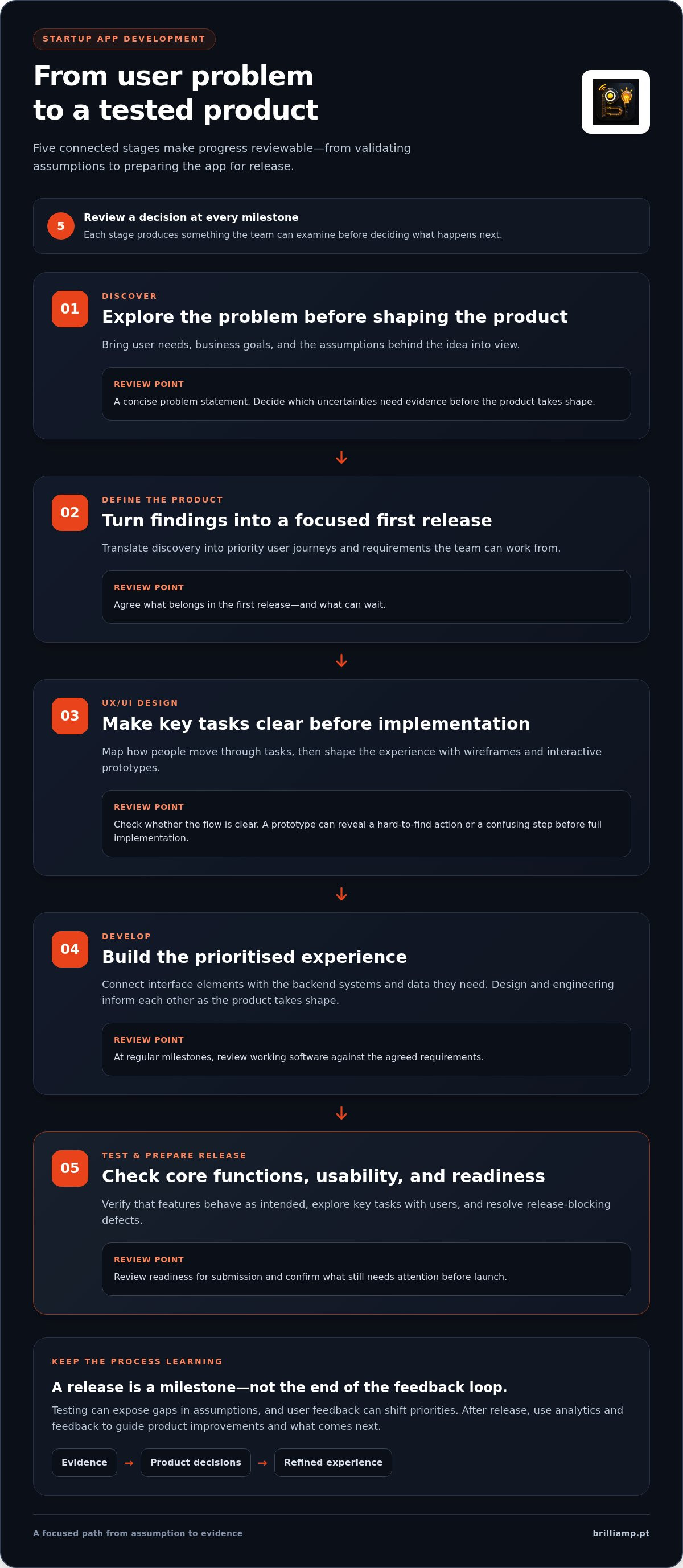
A useful startup workflow makes progress visible. At each stage, founders should be able to review an output, make a decision, and understand what the team will do next. This keeps discovery, design, and engineering connected instead of turning them into separate hand-offs.
- Discovery: Explore user needs, business goals, and the assumptions behind the idea. Review a concise problem statement and decide which uncertainties need evidence before shaping the product.
- Product definition: Turn those findings into a focused direction. Review the priority user journeys and requirements, then agree what belongs in the first release and what can wait.
- UX/UI design: Map how users move through key tasks, then develop wireframes and interactive prototypes. Review whether the flow is clear before committing to full implementation.
- Development: Build the prioritised experience, connecting interface elements with the backend systems and data they need. Review working software against agreed requirements at regular milestones.
- Testing and release preparation: Check that core functions work, explore the experience with users, and resolve release-blocking defects. Review readiness for submission and confirm what needs attention before launch.
How do discovery and UX design shape the product?
Discovery connects user needs with business goals, giving the product a clear purpose. UX design then makes that direction tangible through user flows, wireframes, and prototypes. A prototype can reveal, for example, that a key action is hard to find or that a step in a journey is confusing. These issues are easier to explore in a prototype than after implementation. For a deeper look at this work, see UX Design for Startups: Start With User Needs.
That early learning supports the lean startup methodology: build enough to test an important assumption, then use what you learn to shape the next decision. Testing assumptions early gives founders evidence to guide later product decisions.
What happens during development and quality assurance?
During development, prioritised requirements become working interfaces and connected backend systems. Iterative reviews let founders see real progress. Functional checks verify that features behave as intended, while usability testing shows whether people can complete key tasks without friction.
Feedback needs a filter. When a request comes in, connect it to a user need or product goal, then decide whether to act now, investigate, or defer it. For instance, a request that addresses a barrier in the core journey may deserve attention sooner than an extra feature with no clear link to the product goal. This keeps the roadmap focused instead of turning every comment into a new feature. If you’re shaping a product with a development team, explore Brilliamp’s app development approach.
How can startups avoid overbuilding their first app?
A first release doesn’t need every feature in the original vision. It needs to help users complete a meaningful task and give the team a way to learn from real use. In the app development process for startups, focus isn’t about cutting corners. It’s about deciding what must work now, what can wait, and what still needs evidence.
Use four questions to assess each feature:
- User problem: Which user need does it address?
- Essential outcome: Does it help users achieve the product’s central value?
- Evidence: What research, prototype feedback, or observed behaviour supports building it now?
- Implementation effort: What time and technical complexity will it add compared with its likely value?
How should founders prioritize features for a first release?
Start with the task that delivers the product’s central value. For a booking app, that might be finding an available service and completing a booking. Classify other ideas as essential, useful later, or dependent on evidence. This makes trade-offs visible and gives the team a reason for each inclusion or deferral.
Internal conviction is a starting point, not proof. User research can reveal different priorities, while prototype feedback may show that a planned step is confusing or unnecessary. If evidence is thin, record the assumption and look for a lightweight way to test it before committing to a full build. For deeper guidance on shaping that first testable product, read MVP Development: Test Your Startup Idea.
How can teams balance speed with product quality?
A focused release is not a rushed release. Keep the core journey understandable, reliable, and secure enough for its intended use. Defer peripheral functionality when it doesn’t support the first learning goal, but don’t trade away the basics users need to complete the main task with confidence.
Make trade-offs explicit. If a secondary feature is postponed, note why, what assumption would justify revisiting it, and what evidence the team wants to collect after release. This creates a practical link between scope today and product decisions later.
Quality also depends on the whole experience. A polished screen won’t rescue a journey that breaks between steps, and a working feature can still frustrate users if its purpose is unclear. Protect the essential flow through design reviews, functional checks, and usability testing. Then let actual usage guide what earns a place in the next iteration.
How can founders keep the app development process clear and on track?
A clear process gives founders regular chances to see what’s taking shape and make informed choices. In the app development process for startups, milestone reviews should focus on three things: working outputs, open questions, and next priorities. That keeps the team aligned without relying on vague progress updates.
What should a useful development milestone show?
Each milestone should produce something founders can review, such as a design flow, a working feature, or a tested user journey. A shared project space can capture decisions, dependencies, risks, and unanswered questions alongside that output. For example, reviewing a complete sign-up flow makes it easier to spot friction than hearing that several development tasks are “done.”
Track outcomes, not just activity. Task counts can show movement, but they don’t reveal whether the product is becoming more useful. Better signals include whether a user can complete an agreed journey, whether a key integration works, and which decisions are blocking the next step. Transparent progress helps founders adjust priorities with less guesswork and keeps design and engineering moving toward the same outcome.
How should founders give feedback and manage changes?
Give feedback against agreed user goals and acceptance criteria. If a button doesn’t perform its intended action, that’s a defect to fix. If a new dashboard or sharing feature is requested, that’s additional scope to assess against user value, effort, and current priorities.
Not every new idea needs an immediate yes or no. Record the request, the need behind it, and whether evidence supports adding it now. Then decide whether to include it, defer it, or investigate further. This simple change-control habit protects the release focus while making sure useful ideas aren’t lost.
A proposal can help establish shared expectations about deliverables, priorities, and how changes are handled. For more context, see What to Include in an App Development Proposal. Reviewing that scope together at milestones keeps the plan flexible without letting it expand unchecked.
Brilliamp’s product development combines UI/UX design and engineering with milestone-based reviews. If you’re ready to bring more clarity to your project, book a free consultation to discuss your app’s priorities and next steps.
What happens after development as a startup app approaches launch?
As development wraps, the focus shifts from adding features to confirming the product is ready for real users. Release readiness means reviewing essential journeys, resolving defects that could disrupt them, and preparing the app for store submission. Submission is a release activity, not a substitute for testing: an app can meet store requirements and still leave users confused or stuck.
How can a startup prepare a product for its first release?
Walk through the core user journeys from start to finish. Check that key actions behave as expected across intended devices, that screens remain clear and usable, and that basic accessibility needs have been considered. Record unresolved defects and decide which ones must be fixed before release versus which can be prioritised later.
Store preparation is its own workstream. Organise the materials and information required for submission, and allow time to address review feedback if it arises. For a closer look at that step, see Prepare Your App for App Store Submission. A clear release checklist helps the team separate submission readiness from product quality, while keeping both visible.
How should a startup learn from the first release?
Before launch, choose a small set of analytics tied to product goals and meaningful user actions. If the goal is to help people complete a booking, for example, observe where they begin, whether they finish, and where they leave the flow. Pair those signals with user feedback: numbers show patterns, while conversations can help explain them.
Use what you observe to frame the next questions, not to chase every possible metric. If users start a task but don’t complete it, investigate whether the flow is unclear, a step is too demanding, or another issue is getting in the way. Then turn the evidence into a considered product priority.
The app development process for startups continues after release. App store deployment, analytics, SEO, and growth support can work together as part of an ongoing learning cycle: launch the product, understand how people find and use it, and refine the experience based on what you learn.
If you’re preparing a startup app for release, request a free consultation with Brilliamp to discuss your product goals and next steps. Brilliamp can provide a project proposal within 24 hours.
Turn your first release into a confident next step
A strong app launch starts with clear priorities, not a long feature list. The app development process for startups works best when each milestone turns assumptions into something the team can review, test, and refine. Keep the first release focused on a valuable user journey, while protecting the usability and reliability people need to trust it.
Then treat launch as the beginning of product learning. Use user feedback and analytics to decide what to improve next, rather than guessing which features should come first. When design, engineering, and launch support work together, each decision can carry through from the initial idea to the experience users actually meet.
Brilliamp brings UI/UX design, mobile and web development, and launch support into one product journey. Request a free consultation with Brilliamp to discuss your app and receive a project proposal within 24 hours.
Frequently Asked Questions
What are the main steps in the app development process for startups?
The main steps are discovery, product definition, UX/UI design, development, testing, release preparation, and post-launch learning. In discovery, clarify the user problem and business goal. Then prioritise core features, map user journeys, build and test the product, and prepare it for release. The stages can overlap: prototype feedback or testing may reveal a need to revisit a decision before the team moves forward.
How long does it take to develop an app for a startup?
There’s no reliable single timeline for every startup app. Duration depends on factors such as feature scope, platform choices, integrations, design needs, testing, and how quickly key decisions are made. A focused first release may take less time to shape than a product with many connected workflows. Ask the team to map work to reviewable milestones, dependencies, and decisions so you can understand the project’s schedule and adjust priorities as needed.
Does a startup need an MVP before building an app?
No, a startup doesn’t always need a separately named MVP, but it should have a way to test its most important product assumptions. That could be user research, a prototype, or a focused first release with only the features needed to deliver a core outcome. Choose the approach that provides useful evidence before you commit to a broader build. The goal is to learn, not to create a deliberately incomplete experience.
How can a startup avoid overbuilding its first app?
Prioritise features by asking which user problem they solve, whether they support the product’s essential outcome, what evidence justifies them, and how much effort they require. Keep features needed for the core journey, defer useful extras, and test ideas that still rely on assumptions. For example, prototype a proposed feature before engineering it. This keeps the first release focused without sacrificing the usability and reliability users need.
What should founders prepare before app development begins?
Prepare a clear description of the user problem, intended audience, and outcome the app should enable. Note known constraints, such as a required platform or important integration, separately from assumptions that need testing. A ranked list of core user tasks and open questions can help the team shape scope and design. You don’t need to specify every screen in advance; leave room for research and prototype feedback to refine the plan.
Should a startup build for iOS and Android at the same time?
Build for both platforms at once if reaching users on both is central to the product’s launch goals and the team can support the added scope. A staged release may suit a startup that wants to focus on a specific audience or learn from one platform before expanding. Consider where your intended users are, whether the experience needs platform-specific capabilities, and how each option affects the plan. Choose based on product needs, not assumption.
What happens after a startup app launches?
After launch, the team monitors how people use the app, gathers feedback, resolves issues, and decides what to improve next. Choose analytics that connect to product goals, such as whether users complete a key journey, rather than tracking activity without a clear purpose. Combine usage patterns with user comments to investigate friction and prioritise changes. Launch is the start of ongoing product learning, not the end of development.
